Run the platform in your own environment.
Choose a customer operated deployment when local control, data residency, offline operation, or strict infrastructure ownership is required.
Detect and contain threats across 5G Core, Open RAN, and cloud-native network functions with telecom-aware, kernel-level visibility.
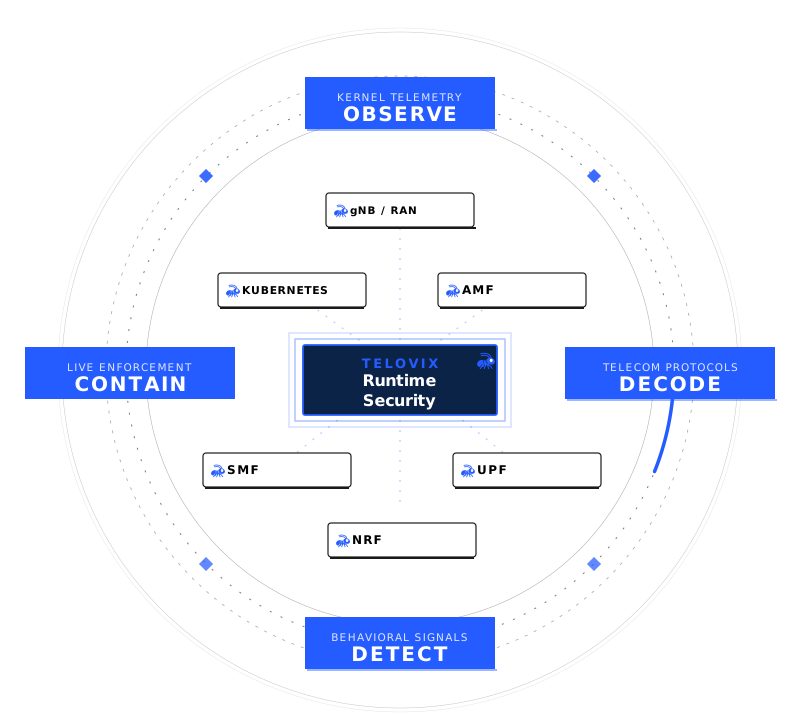
Telovix attaches to the kernel on every node. It sees what is happening the moment it happens.
5G Core, Open RAN, user plane, IMS, 4G EPC, service mesh, and legacy telecom interfaces become connected to process, pod, node, peer, and network function role.
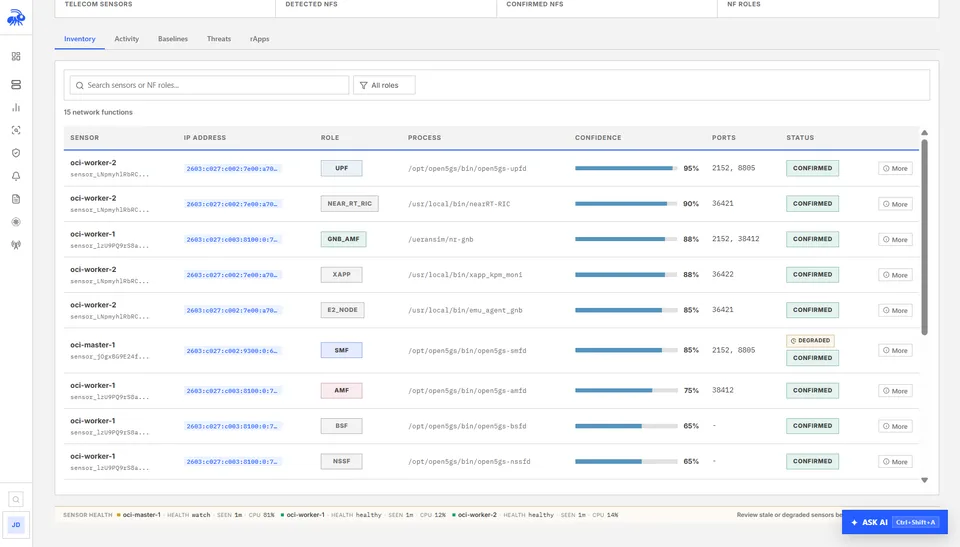
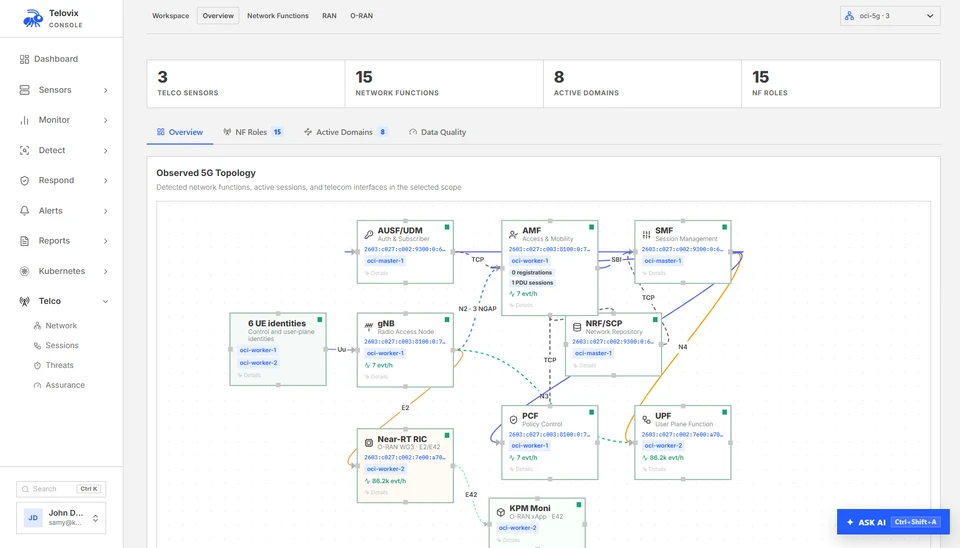
Track PFCP sessions, SEIDs, PDRs, FARs, URRs, GTP-U TEIDs, tunnel churn, rogue RIC insertion, E2 and O1 peers, xApp and rApp behavior, KPM access, and WG11 evidence.
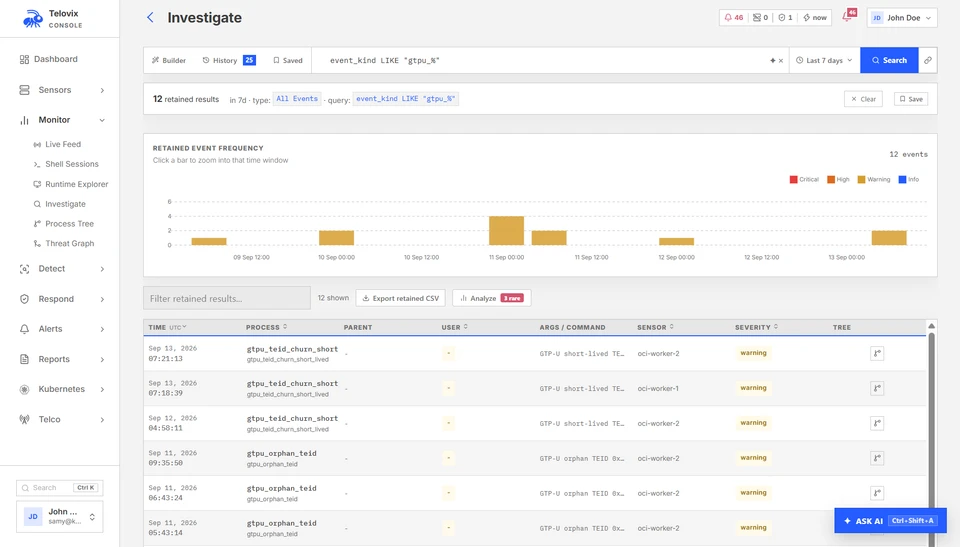
Move from a telecom finding into process lineage, runtime inspector, behavioral fingerprints, fleet correlation, shell sessions, Kubernetes CNF posture, SBOM exposure, and AI assisted investigation.
Converts raw Linux activity into 5G and Open RAN context across signaling, session control, user plane traffic, RAN interfaces, and Kubernetes workloads.
Node activity, protocol behavior, network function identity, tunnel state, Kubernetes context, and anomaly signals become evidence your team can use.
Process execution, sockets, files, privileges, namespaces, pod context, DNS, network flows, and listening services are captured from the nodes running network functions.
NGAP, PFCP, GTP-U, SBI HTTP/2, E2AP, Diameter, RADIUS, SIP, NAS5G, M3UA, and IKEv2 behavior is decoded and tied back to process ownership.
AMF, SMF, UPF, NRF, PCF, CU, DU, RIC, MME, SGW, PGW, HSS, IMS, Diameter, RADIUS, and SIGTRAN roles are inferred from behavior, ports, peers, protocols, and process evidence.
Teams get attack chains, tunnel boundary violations, rogue RIC signals, PFCP session anomalies, peer drift, behavioral anomalies, Kubernetes exposure, SLO impact, and investigation timelines.
Self-hosted or managed deployment. The same telecom protocol intelligence and runtime evidence in both models.
Choose a customer operated deployment when local control, data residency, offline operation, or strict infrastructure ownership is required.
Use the same telecom security capabilities without owning the platform operations.
Protocol decoding, network function context, user plane state, Open RAN evidence, CNF posture, and investigation workflows stay consistent in either deployment model.
Protocol intelligence, network function context, user plane state, Open RAN evidence, CNF posture, vulnerability exposure, and investigation workflows.
NGAP, PFCP, GTP-U, SBI HTTP/2, E2AP, F1AP, E1AP, XnAP, Diameter, RADIUS, SIP, NAS5G, M3UA, and IKEv2 become searchable runtime evidence.
AMF, SMF, UPF, NRF, PCF, CU, DU, RIC, MME, SGW, PGW, HSS, IMS, Diameter, RADIUS, and SIGTRAN roles are inferred from ports, peers, protocols, and process evidence.
PFCP sessions, SEIDs, PDRs, FARs, URRs, heartbeats, GTP-U TEIDs, tunnel churn, tunnel floods, peer drift, and boundary violations are connected to service impact.
Runtime Inspector, process lineage, behavioral fingerprints, shell sessions, attack chains, Kubernetes CNF posture, SBOM exposure, and AI assisted analysis support incident response.
Correlate process lineage, protocol anomalies, attack chains, behavioral drift, shell sessions, and fleet wide patterns across core, RAN, user plane, and CNF nodes.
Track NF role, peer behavior, PFCP heartbeat loss, NGAP procedure failures, GTP-U tunnel churn, Open RAN controller exposure, Kubernetes posture, and SLO impact.
See 5G Core, Open RAN, user plane, Kubernetes CNF, protocol, tunnel, peer, vulnerability, and investigation context through one evidence model.